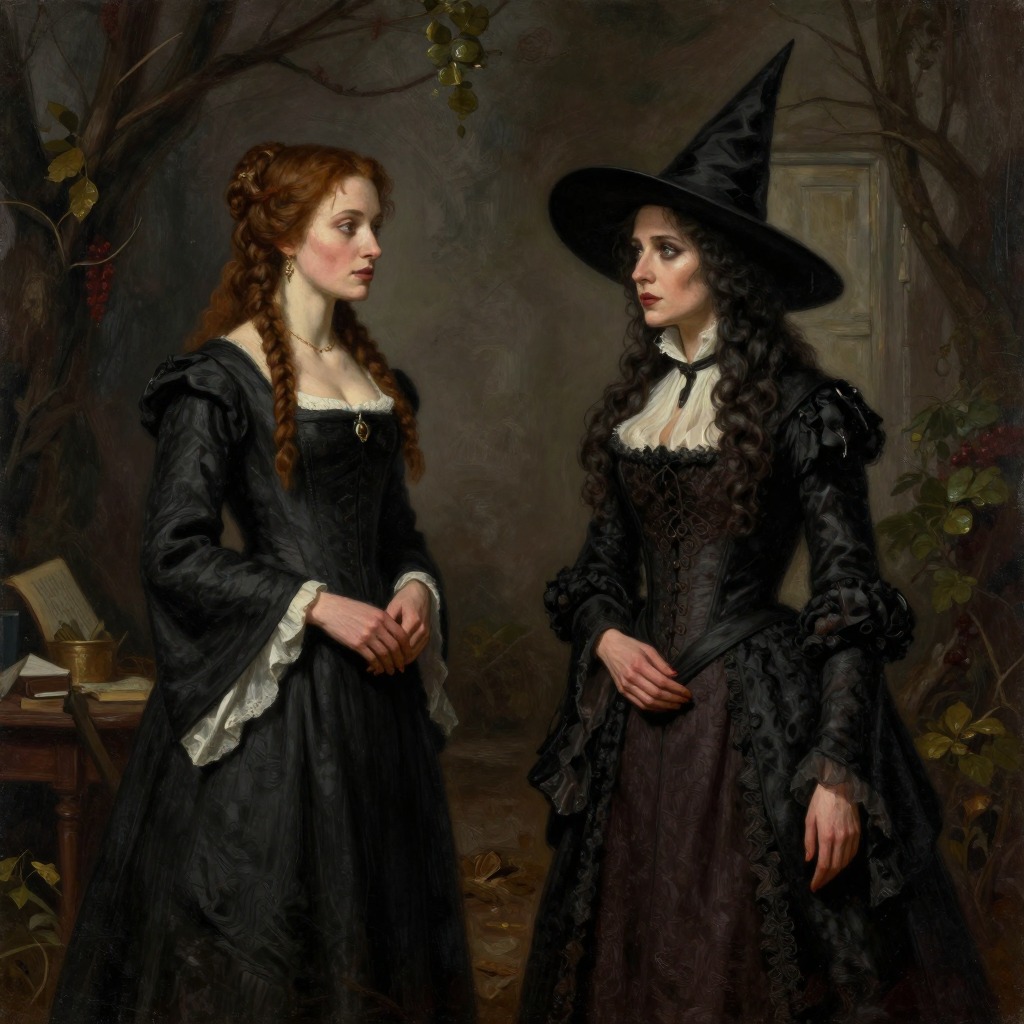
the Prince of the Air
The Prince of the Air is a folkloric title for Satan that appears in Nathaniel Hawthorne's The Scarlet Letter as a charged expression of the supernatural beliefs circulating in Puritan Boston. The phrase is used by two characters—the reputed witch Mistress Hibbins and her young protégé Pearl—to articulate the idea that Pearl is not an ordinary child but a being of demonic origin, linked directly to the ruler of the infernal realm. The epithet crystallizes the community's superstitious dread and serves as a dark counterpoint to the scarlet letter's public shame, suggesting a hidden, diabolical paternity that the town whispers about but cannot prove.
Origin and Folkloric Context
The term "Prince of the Air" derives from ancient and medieval demonology, referring to Satan as the ruler of the earthly atmosphere and the lord of fallen spirits. In the New England of the novel, this concept was part of a living folk tradition: the Puritans believed that witches made pacts with the Devil, signed their names in his black book, and rode through the night sky to attend his gatherings in the forest. Mistress Hibbins, the Governor's sister who was later executed as a witch, embodies this belief system. She speaks of the Prince of the Air as a familiar figure, one with whom she claims intimate acquaintance and whom she expects to meet in the woods at midnight.
Mistress Hibbins's Invocation
During the Election Day festivities, as the procession of magistrates and ministers passes through the marketplace, Mistress Hibbins approaches Hester Prynne and little Pearl. After hinting that the Reverend Arthur Dimmesdale has secretly visited the forest and made a compact with the Devil, she turns to Pearl and says, "They say, child, thou art of the lineage of the Prince of Air! Wilt thou ride with me some fine night to see thy father?" . This remark is both a taunt and a revelation: it publicly names Pearl as the offspring of Satan, aligning her with the witch-lady's own diabolical company. The phrase transforms Pearl from a mere symbol of her mother's adultery into a figure of supernatural menace, one whose true father is not an earthly man but the Prince of Darkness himself.
Pearl's Defiant Adoption of the Title
Later, when a sailor from the Spanish Main tries to kiss Pearl and calls her a "witch-baby," the child retorts with a naughty smile: "Mistress Hibbins says my father is the Prince of the Air! If thou callest me that ill-name, I shall tell him of thee, and he will chase thy ship with a tempest!" . Pearl's response is a remarkable act of self-assertion. Instead of denying the accusation, she embraces the demonic lineage attributed to her and turns it into a weapon, threatening supernatural retaliation. This moment reveals Pearl's wild, ungovernable spirit and her refusal to be cowed by the community's judgment. The Prince of the Air becomes, in her mouth, a source of power rather than shame.
Thematic Significance
The epithet "Prince of the Air" functions as a dark mirror to the scarlet letter. Where the letter A marks Hester as an adulteress within the human legal and moral order, the Prince of the Air marks Pearl as belonging to a different, transhuman realm. The phrase encapsulates the Puritan tendency to interpret the inexplicable—Pearl's strange beauty, her erratic behavior, her intuitive knowledge—as evidence of diabolical influence. Yet the novel ultimately leaves this interpretation unresolved. Pearl grows up, inherits Roger Chillingworth's fortune, marries, and is believed to be happy, suggesting that the "Prince of the Air" was a superstitious label rather than a literal truth. The expression thus stands as a monument to the community's fear of the unknown and its need to demonize what it cannot understand.